Cicero, IN Sliding Glass Door Blinds
Stack lands off the panel you actually use
If you've narrowed things down to this product, these answers should confirm the choice or steer you elsewhere. Either outcome is fine. Ordering the wrong thing in custom sizes is the expensive mistake.
- Service: Sliding Glass Door Blinds for Cicero homeowners
- Service area: Cicero, IN and surrounding areas Getting somebody out to measure is the easy part and happens on a normal schedule. After that the fabricator needs roughly two to five weeks. We give you a specific window when we write the order.
- Insured and bonded
- Serving Cicero, IN since 2008
Expert Sliding Glass Door Blinds for Cicero Homes
Cicero has more sliding door walls per house than any town around it, because the point of a lake lot is the deck outside. Morse Landing carries 359 houses across 35 distinct construction years from 1981 to 2024, and the pattern holds through all of them: a sliding door onto a water facing deck off the main living space. Port Harbour's 32 houses, built 1980 to 2006 on Northport, Eastport, Westport and Inlet, do the same thing on a smaller inlet. The 2015 to 2022 rebuilds inside Cicero Shores push it further, with stacking door walls where a single sliding door used to be.
Here's the part that decides whether you like the result. Whatever you hang has to stack somewhere, and the stack belongs off the operating panel rather than in front of it. A one way draw pushes everything to one jamb and leaves the full opening clear on the other side, which is right where that door is the only way out to the water. A center split parks half the material at each jamb and reads balanced from inside, which suits a fixed assembly nobody walks through. On the Quiet Bay and Moonlight Bay lots in Morse Landing, that door gets used daily through the muggy stretch from about May 25 to September 22, so we set the draw before we discuss fabric.
Signs You Need Sliding Glass Door Blinds
If you notice any of these in your Cicero home, it is worth booking a measure. None of it is urgent, and none of it fixes itself either.
A dog nose has ruined the bottom of every vane
The door and the windows beside it don't match
Builder verticals came with the house and look it
The media room can't get dark because of the door
Several vane carriers have snapped off the track
Vanes have to be shoved aside to open the door
The old vertical blind stacks in front of the handle
A basement walkout door has never been covered
A new build left a 12 foot slider uncovered
Vanes clatter every time the air comes on
How Cicero Window Treatments Handles Sliding Glass Door Blinds
Every job follows the same five-step process. Transparent, thorough, and done right the first time.
Operating panel identified
Header substrate confirmed
Scope and total price in writing
Control type chosen for the walkway
Old treatment taken down and hauled off
Sliding Glass Door Blinds in Cicero
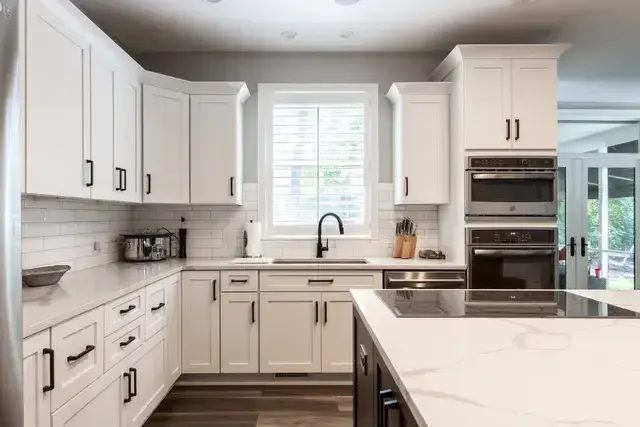
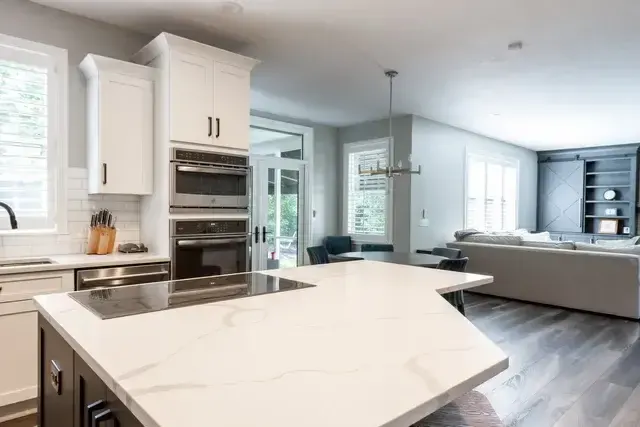
Photographs from real sliding glass door blinds jobs completed by our crew in Cicero and surrounding areas.
What Sliding Glass Door Blinds Includes
Every Cicero job is documented item by item. Here is what the crew covers.
Which panel actually slides established first, standing inside the room with the door open
Draw direction set from that, so the stack parks off the operating panel instead of in front of it
One-way draw and center split compared out loud at the measure, since the wrong one gets shoved aside daily
Handle projection measured, because a treatment that clears the glass can still catch a lever handle
Floor clearance set so nothing drags on the threshold, a carpet edge or a transition strip
Header and wall above the opening checked, since most door treatments want an outside mount and the fastener has to hold
Stack depth figured before ordering, so you know how much glass the stacked treatment covers with the door open
Stack side written onto the paperwork in plain words rather than left to a factory default
Finished width taken past the trim on both sides so an outside mount really closes the opening
Three widths and three heights recorded anyway, plus a diagonal, because door openings settle the same as windows do
The route people actually walk through the door watched, since anything in that path takes the damage
Track length and vane weight matched so a long span doesn't drag at the far end after a season
Wand traverse chosen over a cord loop wherever the door is a daily route in and out
Cordless and motorized options priced where nothing should hang in a walkway
Products specified to conform to ANSI/WCMA A100.1-2022 for cord access
Pets and small children factored into the vane material, since the bottom two feet takes most of the abuse
Scope, dates and a total price put in writing, which IC 24-5-11 requires on residential work over $150
Every vane or panel drawn end to end on install day with the door opened and closed underneath it
What Sliding Glass Door Blinds Cost in Cicero
National figures put custom-fabricated blinds and shades at roughly $250 to $2,600 per opening, interior shutters at roughly $175 to $800 per window, and motorized units at roughly $300 to $1,500 per window installed. Read all of those as national category ranges rather than a price for a door in Cicero. A patio door is one opening but it's a wide one, and width drives this category harder than anything else. Vinyl vanes on a 6 foot door are inexpensive work. Fabric vanes on a 12 foot span, a panel track with five channels, or shutters on a bypass track are a different order of job, because the hardware has to carry real weight across real distance and still glide with one hand. Cicero Window Treatments measures the door, watches how you use it, and prices from that across Hamilton County.
How Sliding Glass Door Blinds Differ by Product
Every product in this trade behaves differently in a room. Here is what that means for this work.
One-way draw: Everything stacks to a single side. It's the right configuration when the operating panel is on one end and you want the whole stack parked over the fixed glass, so opening the door never means pushing a treatment out of the way first.
Center split: The treatment parts in the middle and stacks to both ends. It looks balanced from inside and outside, and it suits a door people use from both directions. Each half stacks shallower than a one-way draw, which matters on a narrow opening.
Vinyl vertical vanes: The least expensive way to cover a patio door and still the most practical in a rental or a high-traffic room. Vanes wipe clean, replace individually when one gets damaged, and don't care about the humidity coming in off the patio.
Fabric vertical vanes: A softer face than vinyl, either as a fabric-wrapped vane or a fabric insert carried in a vinyl channel. It reads much closer to drapery from across the room, and it's the version people choose when the door is in a living space rather than a walkout.
Faux wood vertical vanes: Composite vanes that match a faux wood blind on the windows nearby, so a wall with a door and two windows finally reads as one wall. They weigh more than vinyl, so the track and the carriers get specified for that weight.
Panel track over a slider: Wide flat panels gliding on a multi-channel headrail instead of a wall of narrow vanes. It's the cleanest looking answer on a big opening, and the stack is deeper than a vane stack because every panel is a solid layer.
Vertical cellular on a track: Honeycomb fabric running vertically on its own track, so a patio door gets the same cell structure as the windows. It stacks tight to one side and it's the only option here with the DOE and ORNL cellular testing behind the material.
Bypass shutter track: Shutter panels riding on a track, one passing behind the other, which suits a door because nothing swings into the room. It needs headroom, it needs a straight track, and it gives you louver control that no vane can match.
Roller or solar shade on an outside mount: A single shade hung above the whole opening and dropped over the door when the sun is on it. It doesn't traverse, so you raise it to use the door, which suits a door you open twice a day rather than twenty times.
Motorized traverse: A motor drawing the vanes or panels across the track from a remote or a wall keypad. On a wide door it's the difference between a treatment you use and one you leave open all summer. Batteries are a real recurring cost here.
Sliding Glass Door Blinds FAQ
Questions we hear most often from Cicero homeowners considering sliding glass door blinds.
Sliding Glass Door Blinds Across Cicero
We measure and install in every one of these Cicero neighborhoods. Each has its own page with the build eras, window conditions and mounting notes for that section.
- Sliding Glass Door Blinds in Cicero Original
- Sliding Glass Door Blinds in Cicero Shores
- Sliding Glass Door Blinds in Sunset Bay
- Sliding Glass Door Blinds in Morse Landing and Morse Landing West
- Sliding Glass Door Blinds in Stillwater Cove
- Sliding Glass Door Blinds in Port Harbour
- Sliding Glass Door Blinds in Hidden Bay
- Sliding Glass Door Blinds in Greystone Village
- Sliding Glass Door Blinds in Morse Overlook
- Sliding Glass Door Blinds in Baycrest Addition, Conaway Estates, Auburn Estates and Tamarack
- Sliding Glass Door Blinds in The 46034 shoreline outside town limits
Other Window Treatment Services in Cicero
Cicero Window Treatments handles the full scope of window treatment work. Explore our other services below.
Schedule Your Free In-Home Measure in Cicero
Reach Us Directly
Our team prioritizes scheduled measures and service calls, and books in-home measures during business hours.
Ready to Book Your Measure?
Call us to set up an in-home measure, or to ask about a treatment that has stopped working. We will talk it through on the phone first.